We helped demonstrate a new model for resident uncrewed vessel operations by integrating high-fidelity simulation into a Remote Operations Centre, enabling autonomous deployment, supervision and recovery of USVs from a centralised shore-based facility.
Requirements
As the use of uncrewed surface vessels (USVs) expands, organisations face a significant operational challenge: vessels often require personnel to travel to site simply to launch, recover and recharge them after short missions.
This limits scalability, increases operational costs and carbon emissions, and restricts the ability to deploy fleets of resident USVs for environmental monitoring, inspection and surveillance.
The project also needed to address the growing requirement for effective operator training to safely manage remote autonomous operations.
Solution
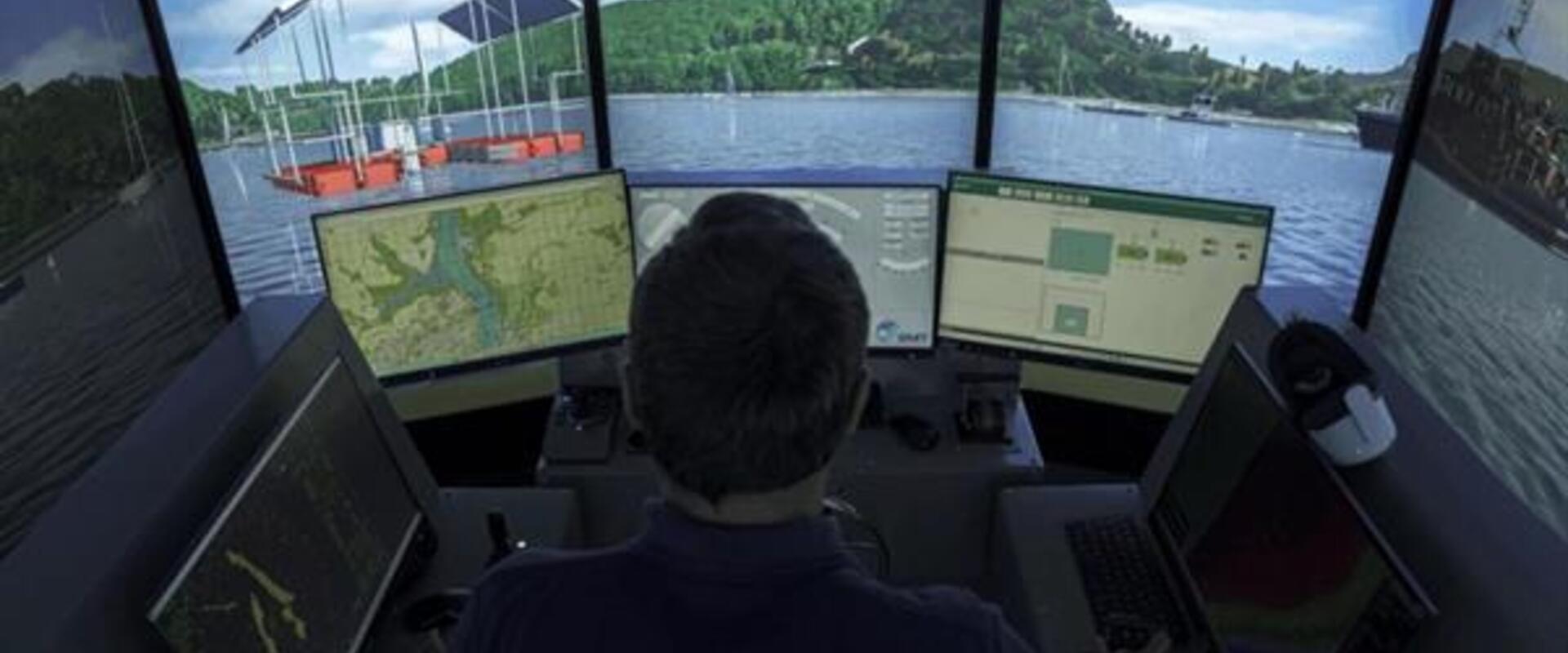
Working with HydroSurv and South Devon College, we integrated our BMT REMBRANDT simulation technology into a Remote Operations Centre (ROC) as part of the Innovate UK-funded ROC + DOCK project.
The solution combined a high-fidelity simulator with HydroSurv's remote vessel control software and a solar-powered automated docking station, enabling operators to launch, monitor, recover and recharge USVs remotely from a centralised facility.
The ROC also provided a realistic synthetic environment for mission planning, operator training, testing and evaluation before transitioning to live operations.
Benefits
The project demonstrated a practical blueprint for scalable resident USV operations.
By eliminating the need for crews at the waterside, organisations can reduce operating costs, lower emissions and increase vessel availability.
A small team can supervise multiple missions across dispersed locations from a single control centre, while integrated simulation improves operator competence and reduces operational risk.
The project also established a new approach to workforce development, helping prepare operators for the future of autonomous maritime operations through realistic, risk-free training before live deployment.