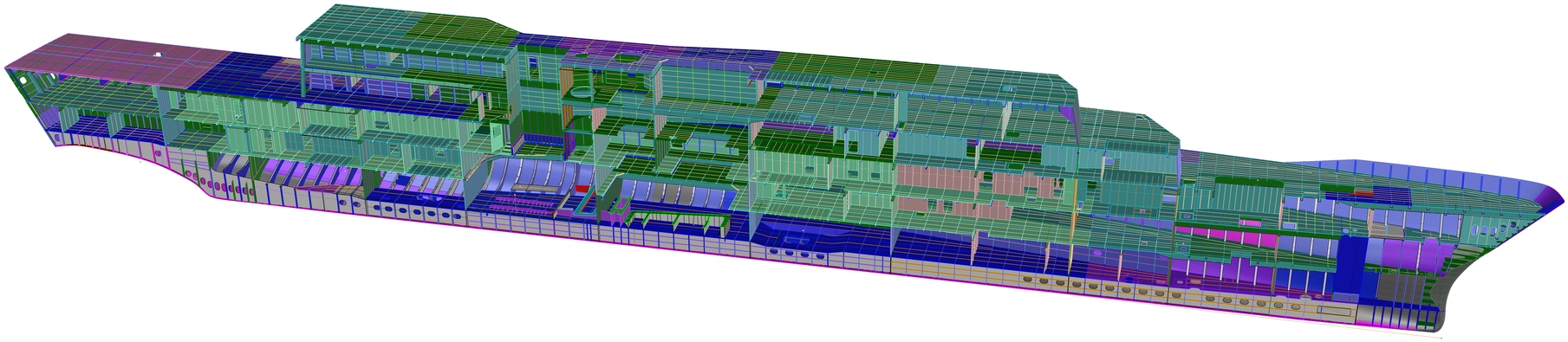
Anzac Class Frigate - Limiting displacement structural assessment
The Anzac Limiting Displacement Project was a structural investigation into the End of Life limiting displacement of the Anzac Class Frigates.
The Anzac Limiting Displacement Project was a structural investigation into the End of Life limiting displacement of the Anzac Class Frigates.
The Anzac Class Limiting Displacement Project was a detailed structural investigation into the End-of-Life limiting displacement of the Anzac Class Frigates. The study assessed longitudinal strength and fatigue life to understand the effects of increased displacement and extended service life.
We undertook this work to evaluate global ship structural performance using advanced finite element modelling techniques, combining traditional strength-based assessment methods with high-cycle fatigue analysis tools.
Phase 1 involved the development of a full ship finite element model using Altair software. This was supported by our deep understanding of the Anzac Class platform, developed through our original designer role on the class, and our experience in large-scale structural modelling.
The model was developed in Rhino 6 and incorporated detailed representation of all primary structural elements, including bulkheads, decks, stiffeners, tanks, and pillars across the full hull structure.
In preparation for analysis, we developed rule-based loading conditions to simulate wave, equipment, self-weight, buoyancy, and slamming effects. The assessment replicated worst-case operational scenarios, including hogging and sagging conditions across two principal load cases representing the vessel’s operational cycle. A structured methodology was also developed to apply a combined set of 574 unique load conditions across the model.
This resulted in one of the largest finite element models developed by the team at the time, incorporating approximately 59,700 surfaces and more than 2.5 million elements. The work demonstrated our capability to undertake full-scale global ship structural assessments using high-resolution finite element techniques, while operating at the limits of available modelling and processing tools.
Phase 2 focused on longitudinal strength and fatigue life assessment of the frigate structure. The results confirmed strong global structural performance, with the platform demonstrating robust resistance to fatigue and satisfactory longitudinal strength characteristics. The findings provided the customer with a clearer understanding of platform capability and constraints in relation to extended service life and increased displacement scenarios.
This program reflects the type of complex structural analysis capability delivered by AMT, now part of BMT, combining deep platform knowledge with advanced computational modelling to support informed naval asset decisions.
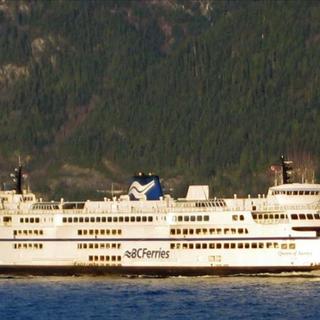
We developed the plans and designs for the mid-life upgrade of a C-class ferry.
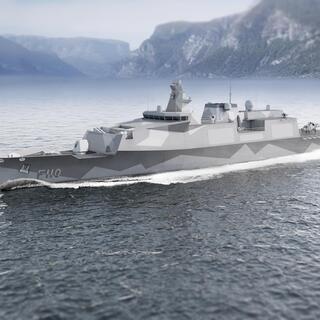
VENATOR-110 Frigate is a flexible and tailorable modern warship, able to provide a spectrum of credible capability from Maritime Security to Warfighting worldwide at an affordable procurement cost.
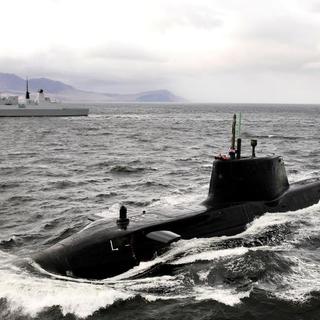
We developed an Astute Class OM Strategy which provides the framework within which OM is to be carried out through-life and across the Astute Class.
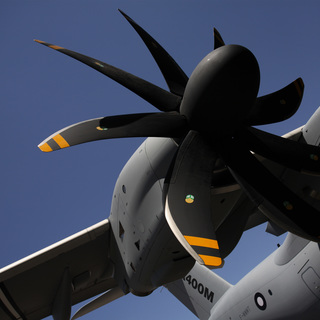
The Airbus A400M is a four-engine turboprop military transport aircraft being designed and manufactured by Airbus Military, we supported the MoD A400M Project Team with the development of the VfMB required to support the In-Service Support Assessment Phase.