
13 November 2026
Project management, applied to projects delivering environmental outcomes, plays a central role in shaping environmental results. From climate adaptation programmes to major infrastructure, projects are the primary mechanism by which environmental intent is translated into action. When such projects succeed, they enable long-term environmental resilience whereas in contrast, delivery failure has large impacts potentially resulting in environmental harm, regulatory risk and loss of public trust. Despite this, research indicates that a large proportion of projects fail to deliver their intended outcomes, raising questions about the assumptions that underpin how projects are understood and managed (Flyvbjerg, 2009; Gupta et al., 2019).
By drawing on insights from biology and environmental sciences, this paper explores whether projects can be viewed as living systems and the impact this has on project delivery. It does not argue that projects lack review mechanisms such as performance reviews and gate meetings intended to assess how the wider project is performing and whether change is required. These mechanisms, however, do not always work as intended, particularly where governance is weak, overly rigid or focused on compliance rather than responsiveness. This paper challenges the traditional approach that projects are rigid structures that should not deviate from the baseline plan. Additionally, it will examine how reframing failure as informative rather than terminal alters how learning, adaptation and success are approached. Through this lens, adaptation acts as a prerequisite for long-term viability, enabling greater project resilience.
Why Traditional Project Management Assumptions Break Down in Complex Environments
Projects are often managed through a ‘textbook world’ lens whereby success is assumed to follow from thorough upfront planning and adherence to predefined processes (Sanderson, 2012). In theory, this methodology offers control and predictability, but in practice the persistent prevalence of project failure suggests a fundamental limitation. Emerging studies, including Marrewikij et al. (2024), challenge this rigid mindset, arguing that projects are better understood as imperfect and evolving systems rather than static structures that should be protected from deviation. This does not imply that projects are unmanaged or lack opportunities for reflection. Many delivery environments include regular assurance checkpoints and governance processes that aim to assess project performance. In principle these mechanisms should look beyond individual tasks and consider the wider project however in practice this is not always the case. Where governance is weak, overly rigid, compliance-led or insufficiently responsive, reviews can be focused on adhering to the plan. Under these conditions, project controls risk reinforcing existing assumptions rather than surfacing emerging misalignment.
The Agile Manifesto sought to address some of these limitations by recognising uncertainty and integrating planning with execution through iterative delivery and regular reflection (APM, 2025; Anifa et al., 2024). Agile enables teams to respond to changing requirements and is well suited to contexts where needs arise during delivery as opposed to being fully defined at project initiation. However, whilst agile is explicitly designed to accommodate change, adaptation is often concentrated within delivery practices and team-level execution. In many cases, the wider system in which the project operates, such as governance structures and broader stakeholder expectations, remain comparatively fixed. As a result, learning and adaptation are applied locally within delivery cycles, rather than consistently shaping decisions across the wider project system (Williams, 2005).
Proper controls should enable intelligent adaption, not prevent it, thus the challenge lies in distinguishing between effective controls and inflexible controls that prioritise conformance to an original baseline despite changing conditions. Viewing projects as living systems builds on agile principles by extending adaptation beyond delivery mechanics alone. It recognises that projects are embedded within complex, evolving environments shaped by regulatory change, stakeholder expectations, ecological pressures and organisational capacity. In such context, long term viability depends not on strict conformance to an initial plan but on the ability to sense change and redirect effort accordingly.
Reframing Projects as Living Systems
Living systems provide a useful lens for understanding how complex systems respond to sustained pressures. Biological organisms facing constraints typically have 2 options, either redirect energy to adapt to their environment, or gradually degrade over time (Garland, 2022). Adaptation may be behavioural, structural or physiological but in each case, it enables the organism to persist under changing conditions. Where adaptation does not occur, continued exposure to stress reduces organism resilience and decreases the chance of survival.
Climate change provides an illustration for this dynamic. It is not triggered by a single, stand-alone event, but by sustained pressures acting on environmental systems over long periods. Rather than causing immediate collapse, this stress is expressed through observable symptoms that become slowly visible over time.
These include rising sea levels, irregular weather patterns and increasing global temperatures that signal increasing strain within the system (Abbass et al., 2022). Pressures then manifest as localised failures, one prominent example being coral bleaching (Hoey et al., 2016). In response to ocean warming, coral reefs undergo visible whitening due to the breakdown of a long-established relationship between the coral host and algae symbionts, resulting in the characteristic bleached appearance (Van Woesik et al., 2022). Importantly, bleaching does not cause coral reef systems to perish in totality. Some species survive by adapting, for example by altering gene expression to increase tolerance to thermal stress (Bellantuono et al., 2013; Winslow et al., 2024). Through this adaptive response, parts of the reef system continue to function while parts that do not adapt are likely to be lost (Naugle et al., 2024). The ability to sense environmental change, respond to stress and redirect effort accordingly is therefore critical to longevity.
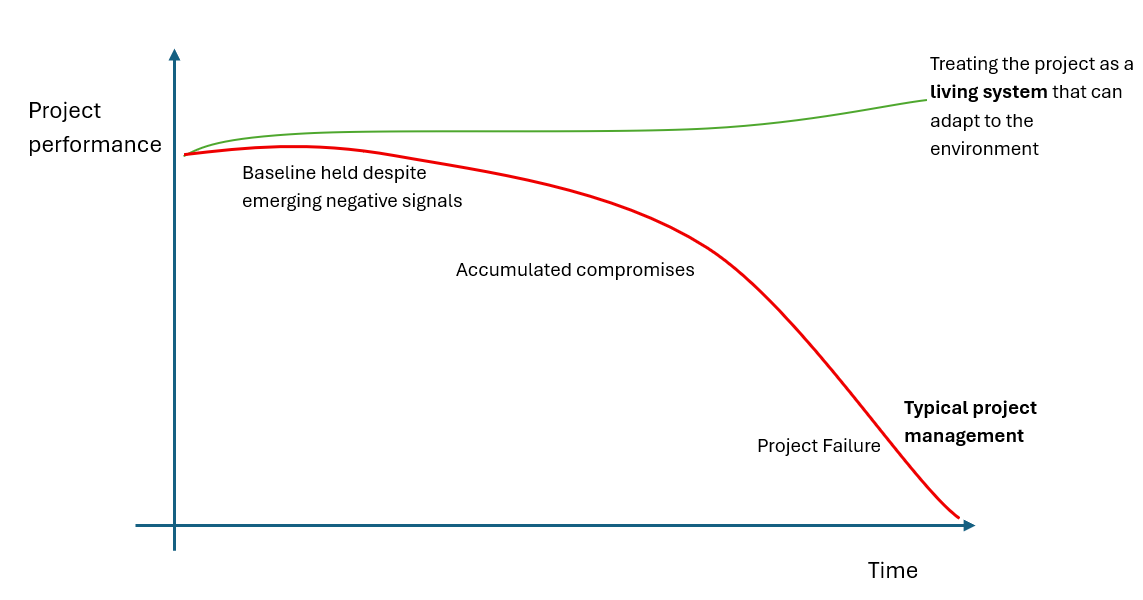
Projects operating within complex environments exhibit the same underlying dynamics (Sato et al., 2015). Pressure accumulates gradually through capability constraints, changing stakeholder expectations and external influence, becoming visible through localised failures such as missed milestones, quality issues or delivery compromises. These signals indicate increasing misalignment between the project and its environment, manifesting as a growing mismatch between delivery assumptions and evolving client requirements shaped by that environment. At these moments, project teams face the same fundamental choice observed in living systems; either adapt by redirecting energy and evolving or, continue as planned and degrade over time.
"Project teams face the same fundamental choice observed in living systems, either adapt by redirecting energy and evolving or continue as planned and degrade over time.”
The living systems perspective reframes adaptation not as deviation from good project management, but as part of what effective project management requires in complex environments. By recognising changing conditions, interpreting feedback and adjusting decisions, it indicates that control is operating in a responsive way. Project resilience is therefore strengthened not through rigid adherence to the plan but through the capacity to maintain alignment between the project and environment in which it operates.
Viewed through this living-systems lens, project failure should not be understood as a discrete breakdown but as an evolving process. This aligns with Marrewikj et al. (2024), who argued that failure is better understood as emergent rather than terminal. Micro-failures act as feedback signals that highlight where adaptation is required, creating opportunities to adjust course before misalignment becomes irreversible. The critical question is whether governance and control mechanisms are capable of responding to those signals or whether they suppress them in favour of preserving the original plan, potentially leading to project failure.
This perspective also highlights a limitation in how learning is often handled in project management. Learning is often treated as retrospective, captured at project close-out once delivery is complete (Jugdev, 2012; Dowson, 2024). ). At that point, learning may inform future initiatives, but it cannot influence the delivery of the project in which failure emerged. In contrast, living systems demonstrate that adaptation must occur while the system remains viable; learning after collapse offers no benefit (Gomulkiewicz and Shaw, 2013). Projects do not lack review points – formal checkpoints intended to assess progress and trigger intervention are in place. The difficulty arises when governance is overly rigid, escalation pathways are weak or if success is defined too narrowly around compliance with the existing plan. In these circumstances review points may fail to translate insight into action and thus whilst feedback is generated, it is not used.
Learning through delivery: an applied example
The implications of treating projects as living systems are visible in practice. This dynamic was observed directly during a pro-bono project that BMT delivered for a charity. A graduate team of three set out to deliver a piece of project management support focused on improving the charity’s use of Google Adverts and upskilling the team to run future campaigns independently.
At the outset, delivery was structured around a clear plan with an iterative lifecycle. An advert was subsequently launched to promote the sale of the charity's t-shirts, with the expectation that performance data would be used to inform incremental optimisation. While early indicators suggested the ad was performing adequately, deeper analysis revealed underlying campaign set-up issues that sat beyond the BMT team’s expertise and support mechanisms available.
In this moment, the project faced a familiar but often under-acknowledged choice, continue to pursue the original delivery approach despite increasing evidence of misalignment, or adapt in response to the signals emerging from the environment. The decision was taken to adapt. This decision mirrors adaptive mechanisms described earlier. Continued adherence to the baseline would have increase the likelihood of gradual degradation and eventual failure, see Image 1. Rather than persisting with an approach that no longer suited the environmental constraints, energy was redirected.
Crucially, whilst the route to delivery changed, the underlying objective remained unchanged – to increase visibility and awareness of the charity’s work in marine conservation. With support from colleagues within BMT, the project adapted to focus on delivering a social media campaign that operated within the constraints of capability, time and expertise. Although the form of the project changed, its purpose did not.
This adaptation remains ongoing and illustrates how projects, like living systems, can respond constructively to environmental constraints when feedback is recognised and acted upon. By responding to signals of misalignment, the project avoided degradation and continued to deliver meaningful outcomes. As with biological systems, resilience was not achieved through rigid preservation of the original plan, but through timely adaptation to the condition in which the system operated. Viewed through this lens, adaptation is not a deviation from success, but the mechanism through which success is sustained.
What Changes is we treat projects as living systems?
In treating projects as living systems we can alter what effective project management looks and the value it delivers, especially in environmental and sustainability led contexts.
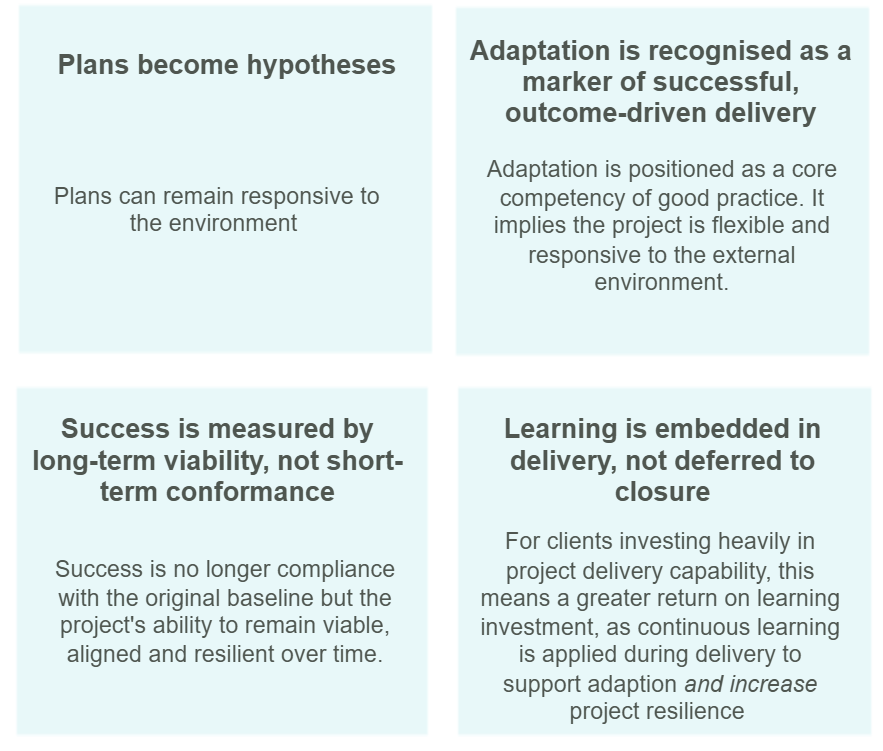
The high prevalence of project failure suggests that issues with delivery are not only in execution but in the way projects are conceptualised and governed. Existing project management includes mechanisms intended to review performance, assess pressure and guide change, yet these do not always work effectively where governance is weak, overly rigid or focused on compliance rather than learning. The issue is therefore not a lack of control, but the need for controls that are able to respond to real conditions.
By taking inspiration from the natural environment, we can reframe projects as living systems that must adapt to their environment. This approach explains what we already observe but struggle to articulate. Projects experience stresses in response to changing conditions and exhibit early signals of misalignment to their environment before failure is declared. In treating these signals as informative rather than problematic, it enables learning to occur while the project remains viable.
Viewing projects as living systems will shift the role of project management from preserving the baseline plan to sustaining alignment with the environment in which the project operates. Resilience is increased not by rigid adherence to the baseline and overdependence on the plan, but through capacity to interpret feedback, adapt decisions and redirect effort in response to real-time information. In this mindset, adaptation is not a loss of control but a demonstration of it. Projects that can sense change, learn during delivery and adapt accordingly are better positioned for successful delivery and therefore environmental outcomes.
Similar to living systems, projects are not intended to exist indefinitely, rather they are created to fulfil a purpose. They operate within a particular environment and ultimately come to an end once that purpose has been served. This further reinforces the need to view project management not as the preservation of a fixed plan but as the ongoing task of sustaining alignment, viability and purposeful delivery throughout the life of the project.
In conclusion, reframing and managing projects as living systems offers a more realistic and responsible approach to project delivery whereby learning, adaptation and resilience are essential conditions for sustaining success rather than signs of deviation from it.
"Projects do not fail because they change, but because they are unable to adapt."

Florence is a Graduate Management Consultant with a background in Biological Sciences, bringing a scientific and analytical approach to project delivery and complex problem-solving. With experience in the defence sector, she holds qualifications in project management and controls, including APMG PPC Practitioner and APM PFQ. Alongside her client work, Florence is committed to pro bono consulting, applying her skills and experience to create positive impact for organisations and communities.

Alex Leppard
This paper explore how knowledge collapse and model collapse could impact the quality and reliability of AI-generated information.

Dr Tim Curtis
This paper addresses that reality. We introduce a practical way to diagnose transformation maturity while the organisation is still in motion. The Strategy Canvas helps leaders make sense of what is really happening across the whole organisational system.

In a world where complexity is the norm and certainty is rare, adaptability isn’t a luxury, it’s a necessity. And when we combine it with empathy, structure, and a commitment to quality, we create programmes that deliver real, lasting value.
Tim Curtis
Most transformation programmes fail—not because of poor execution, but because they never truly understood the race they were competing in. The BMT Strategy Canvas changes that.