
25 June 2026
Whilst it is now with certainty that we will share our future with Artificial Intelligence, it is less clear what that relationship will look like and how it will unfold. Within Consultancy, a sector driven by change and transformation, it is imperative that we remain confident in being able to answer what value does the ‘human' hold in our work?
The complexity of the question should not delay our response – there may not be a right answer, but the only wrong answer is not to explore the question at all. In order to move forward, we need to consider why, when and how AI is used within our workflows, and what that looks like for us as the ‘human in the loop.’
The title is deliberately contentious – playing devil’s advocate to the often more positive, or at least balanced, framing of AI in our workplace. The conversation tends to work around phrases such as ‘the value of the human’, or how ‘off-loading’ can support us with ‘higher level thinking.’ Is this softer light fair, or just softening the blow to the human in the loop? Ultimately, the crux of the matter is still the same - if we keep putting off answering this question, then we miss the opportunity to establish a valuable, credible, effective process when working with AI. This is not an expectation that we have the knowledge and means to immediately start modifying our ways of working – that task should not be underestimated – but that we should at least consider why and how we might need to.
Foregoing the irony, the challenge of writing a paper on using AI within workflows, provides perfect context to establish the conundrum – how much should AI be used in this instance? When humans consider using AI in their workflows, they have four potential options:
Option One: Irrelevant
This is not to say that this option is irrelevant but that the use of AI is irrelevant – the workflow is dependent on human experience, knowledge and judgement and the inclusion of AI would add significant risk, slow the process and/or devalue the output. The writer goes ‘old school’, completes their own research, working through sources, pulling out the relevant information and builds the paper from scratch.
Option Two: Tool
The writer introduces AI tools to assist them, and uses them to conduct the easily automated tasks, but not rely on them to produce a final output. It may be that it is used to capture meeting notes or condense a text - nothing creative or critical. Given that there is often little ambiguity in the ask or the output (expect short, sharp prompts with clear assurance), Option Two provides a safe entry way into the inclusion of AI in workflows.
Option Three: Co-Creator
The writer works collaboratively with AI, using it to support in the creation of the final product. AI is used to scope content, answer directed questions, structure paragraphs and summarise findings, so becomes an integral part of the critical thinking process. Within Option Three, the boundaries between AI and the human become blurred, the ways of working more complex, and the level and type of risk starts to shift.
Option Four: Replacement
The human in the loop is now there in a management and assurance role, with AI being used to replace as much of the ‘heavy lifting’ in the workflow as possible. The human provides the scope, requirements and data; AI is used to pull and filter the sources, formulate a structure, and build a fully referenced output. The AI becomes the source of the creativity and critical thinking, with the human providing feedback and realigning where necessary, before final Quality Assurance.
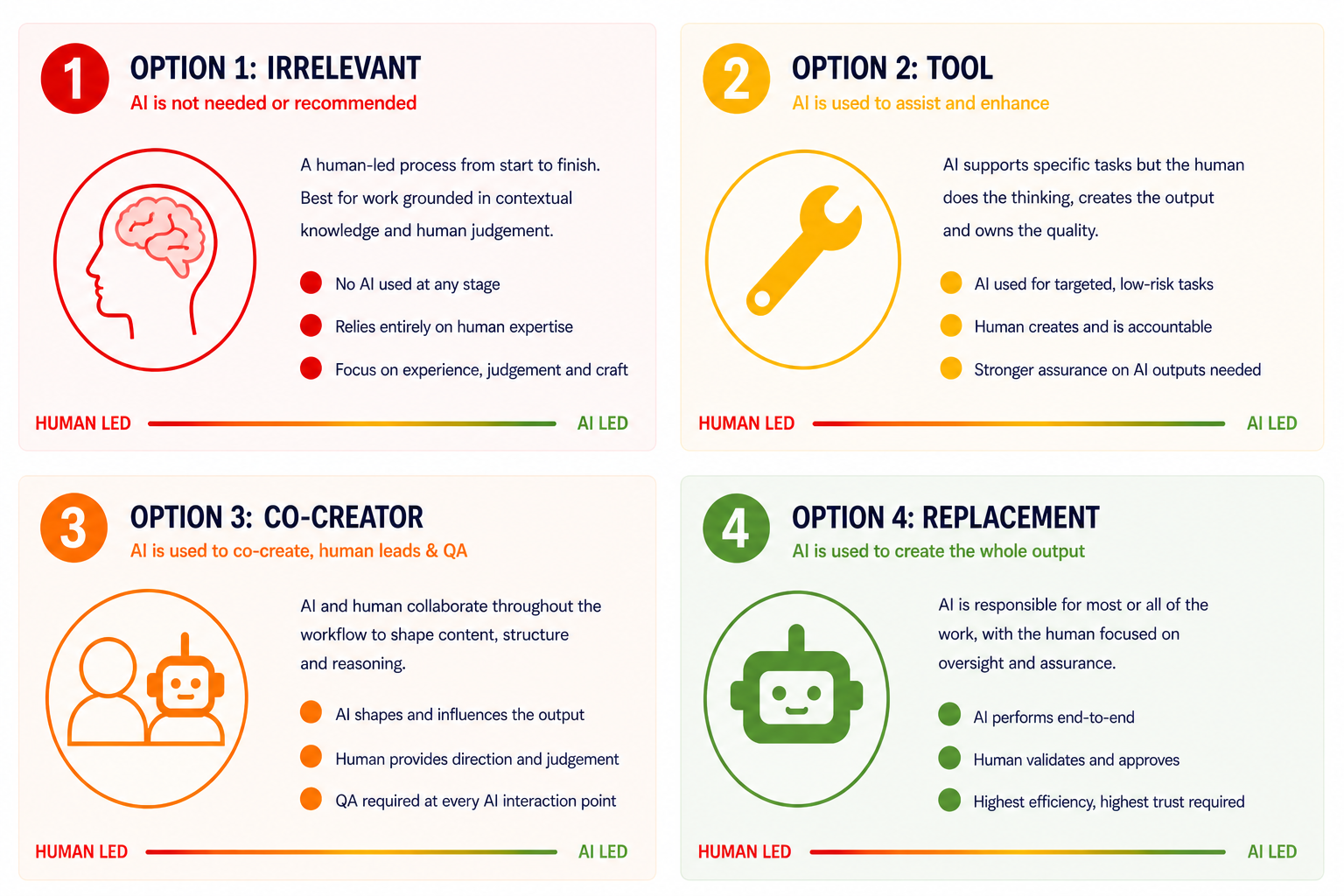
At this point, it is useful to clarify that the four options are based not on individual tasks, but the workflow – that is, not on the single units of work, but the end-to-end process that is created when tasks are linked together. This is a key differential when understanding and appreciating the impact AI could have on the bigger picture. Whilst there might not be any concern about using an AI tool on one task when it sits in silo, are we still confident in its use when AI becomes part of the chain?
In the not-too-distant past, these were hypothetical – there was much discussion and debate around the incoming capabilities of AI and all the tasks that we could ‘off-load’, creating effective and efficient workflows. But they are not abstract anymore and represent very real choices that we need to make on a daily basis. And the difficulty is, there are no hard and fast rules about what is right and wrong – at least not yet, and certainly not at the ‘worker bee’ level. The step change from tasks to workflows, means we need to approach it holistically - there is such a level of complexity to this problem that it becomes obvious why people struggle to grasp the true impact. Nevertheless, we can, and should, start to consciously interrogate which of the four options might work best – this is not to say that it is correct every time or alleviates all concerns, but it introduces an early level of scepticism and justification to our new ways of working.
To help break down this process and make decisions that are appropriate, valuable and credible, work through these Five AI Workflow Considerations before introducing AI into your workflow.
5 AI Workflow Considerations:
1. Task Suitability and Complexity - Is the task suitable for AI given its complexity, data requirements, and tool capability?
Consider what kind of work it is, and whether AI is technically and conceptually capable of contributing meaningfully to the task. Think about the information you gather when away from your computer – ‘water-cooler chats’ with colleagues, inferred preferences during client meetings – which may prove highly valuable to your project but which AI cannot access.
2. Risk, Impact and Assurance - What is the risk if AI outputs are wrong or biased, and can appropriate assurance be applied?
Consider what happens if AI gets it wrong, and how we control that, given that risk and assurance are entwined: higher risk demands stronger controls, management, and justification. Think beyond the day-to-day impact and look at ethical, reputational and operational impact too.
3. Human Capability and Judgement - Do users have the skills and judgement needed to use AI responsibly without reducing human capability?
Consider if people can use AI safely and intelligently, ensuring that AI is enhancing rather than replacing human expertise and accountability. Think about both AI literacy and someone’s ability to construct effective prompts, as well as their ability to challenge AI reasoning.
4. Value and Efficiency - Does using AI deliver value, even after additional author time, QA effort, and costs are considered?
Consider if using AI is actually worth it, assessing if efficiency gains outweigh hidden costs, such as licences, training, and dependency. Think about whether it might take longer to assure (and fix) the output than it would for a human to create it in the first place.
5. Governance, Security and Compliance - Is the use of AI compliant with policies, security requirements, and accountability expectations?
Consider if this can this be done safely and transparently within the rules, given that even viable, low-risk AI use should not proceed if it violates organisational, legal, or regulatory constraints. Think about whether, at the simplest level, that data is allowed to go through that AI tool, no matter how effective or efficient.
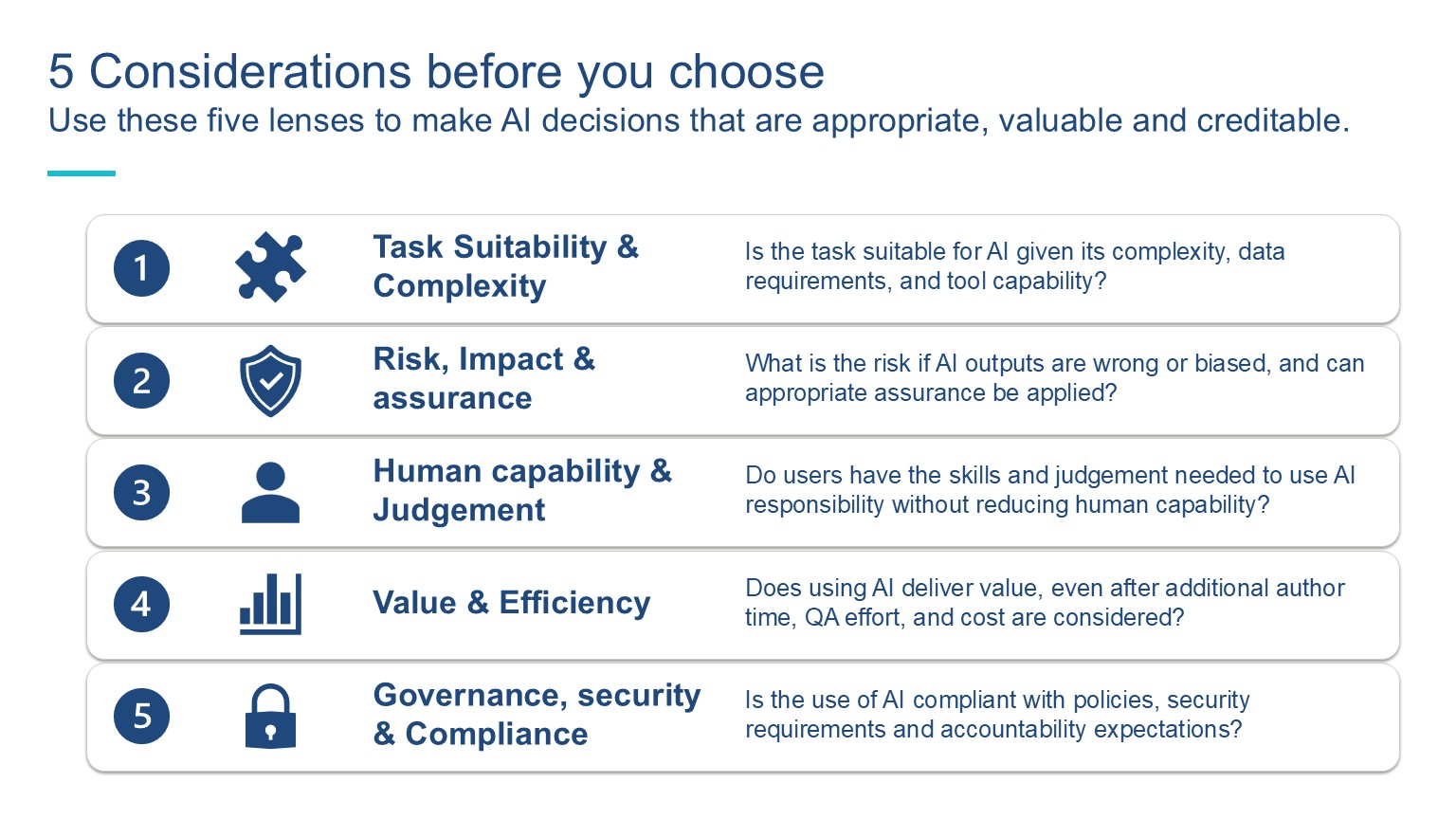
For many, the decision to include AI is either obvious or subconscious and has already become an embedded part of our working practices. But does that alignment still fit when sense checking these considerations against full workflows and not just daily tasks? This is not a warning to not embrace AI or use it to support workflows, but to be aware of where it adds value, without detracting from the value of the human.
Ultimately, the key difference in this approach is that we are making the decision about if and where to use AI in a workflow explicit, conscious, intentional. By building in check points and questioning qualities of the workflow, such as task complexity, completeness of data, risk appetite, etc, we are interrogating the appropriateness and value of our deliverables up front. It is this judgement that should provide the basis for continued and embedded structured scepticism, making our decisions auditable, and therefore enhancing credibility.
After checking the workflow against each of the 5 considerations and deciding which option may work best – where AI will either be irrelevant, a tool, a co-creator, or a replacement - what does the new workflow look like?
Whilst the human is often viewed as the contextual ambiguity, we are still at a point where our AI tools provide a technological unknown: it is not always clear just how well AI is going to perform against the task set, especially if it is unknowingly pushed beyond capabilities, and is dependent on how the human uses the tool in the first place.
There also needs to be considerations against time, cost and quality, as with every project, so this model is providing a ‘starter’ for discussions, and must be flexible to individual requirements.
If we consider this to be our generic workflow:
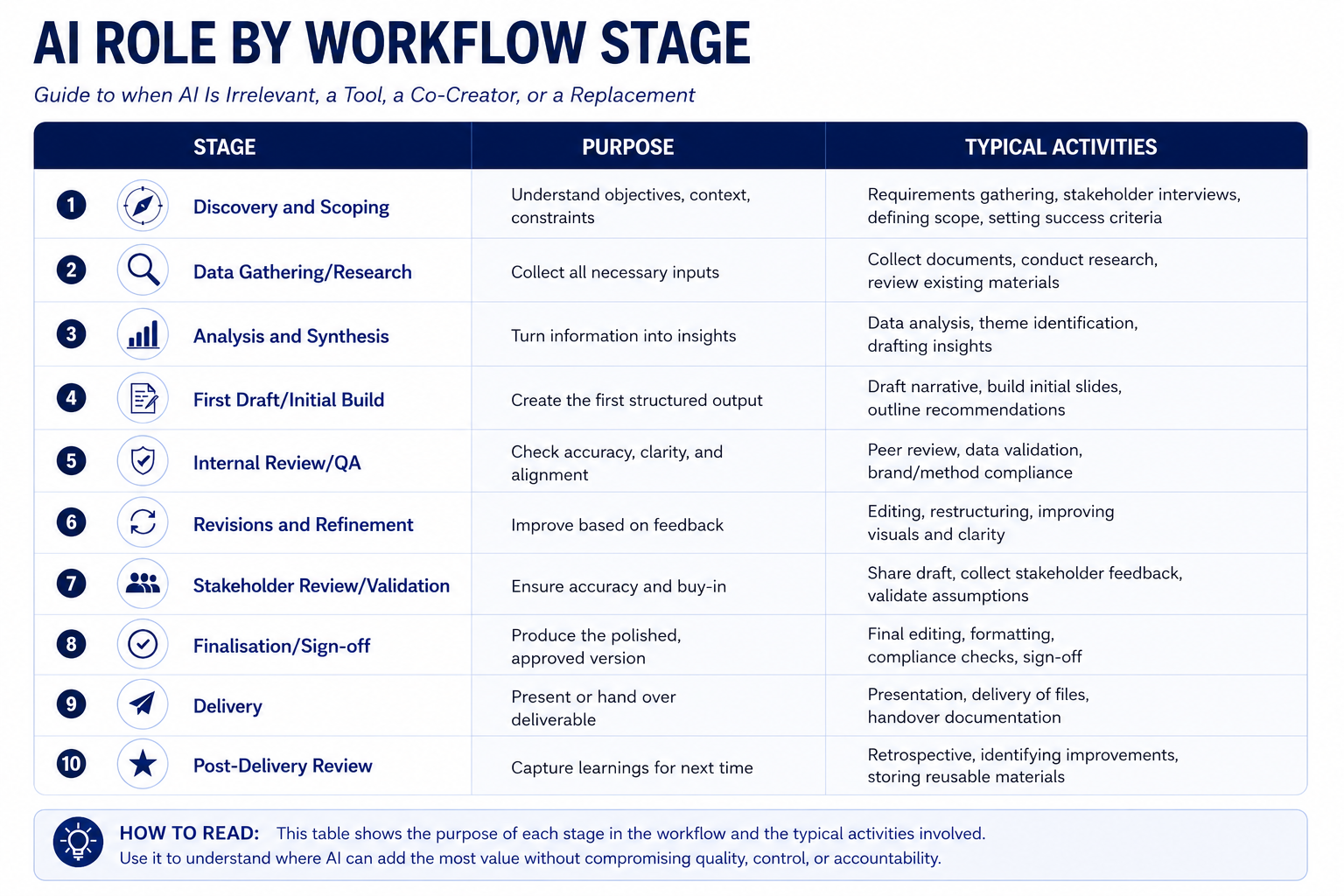
Each option would look like this:

Option One: Irrelevant
What this workflow looks like in terms of utilising AI is irrelevant considering the purpose of Option One is to keep it a purely human driven process. However, as we become more aware of aligning tasks to tools, we should not become complacent with aligning tasks to people. How you break down the tasking between data gathering, initial build, review, revisions, etc, will depend on the required deliverable vs the capability of the person. Within Option One, there needs to be an awareness that we cannot compare human capability in the same way we can compare AI capability: here we will need to look at experience and previous delivery, as much as technical knowledge and skill set. This option is for those workflows grounded in contextual knowledge and human judgement; therefore, we must not lose sight of picking the right person for the job.
Option Two: The Tool
When using AI as a supporting tool (but not relying on it to produce the final deliverable), the balance starts to shift in the early stages of the workflow. The data gather and formatting may become more effective and efficient, but a new, or at least stronger, layer of assurance now needs to be built in - it is the authors responsibility to check and validate the work done by AI at this point. Without this, there is a risk that incorrect or unverified information will ‘slip through’ and impact the quality and trustworthiness of the final product later down the workflow. It is imperative that this is done before the author begins to formulate their structure and argument so as not to be building on false information or assumptions. The extent to how much AI can be used as a supporting tool as part of Revisions and Refinement and Finalisation will depend on what was raised during Internal Review/QA and what AI capabilities you have access to - the complexity and risk of the task should also be considered as keeping all review processes and amendments human led will ensure a more valuable and credible output.
What this looks like in our world:
A project manager is asked to prepare a stakeholder engagement plan for a complex warship refit programme. AI could generate a competent template in minutes. But the real value of this plan lies in knowing that the dock master has concerns about schedule pressure, that the ship's company have been through two previous programme delays and are sceptical of new timelines, and that the client's project sponsor responds better to visual summaries than written reports. None of this is in any document. The Consultant's lived understanding of the environment is the deliverable - the formatting around it is where AI can help.
Option Three: Co-Creator
This is the most difficult of the four options to balance. Given the amount of information and data that now needs to move between human and AI, you not only need to be strict about how quality assurance is conducted on outputs at every stage that AI is used, but you also must be confident (and transparent) with the data and prompts providing the input. It is about understanding and managing your role as both creative guidance and assessor. As a co-creator, AI is given the capacity to shape and influence not just the content and structure, but the judgement and reasoning behind the deliverable. In turn, the accountability and capability of the human author must reflect the increased level of assurance required – it is vital that we question if the person has the skill set, capacity and expertise to QA in these workflows. Where Option Three is used in workflows to generate a project schedule or capture actions from a meeting, the assurance process may be less intensive than if the AI was being used to co-create a Thought Leadership piece on Systems Thinking to support Sustainability, but it is no less important.
Option Four: Replacement
When AI is used to replace the human at different stages of the workflow, there is a risk that the ‘value’ the human brings is either skewed or lost completely. Without deep diving into the merits of different AI tools, the strength of the prompt, or the capability/capacity to thoroughly QA AI outputs, an AI heavy workflow works on the premise that the final deliverable will provide the same level of validity and credibility, whilst increasing effectiveness and efficiency. That requires a significant level of trust in both the tools doing the work, and the humans checking the answers. Choosing Option Four means knowing what the baseline data is in order to truly measure whether the full inclusion of AI really increased the effectiveness and efficiency of the workflow, knowing whether the risk of losing the creativity/critical thinking of the human in the loop is acceptable, and knowing that the assurance process is failsafe.
What this looks like in our world, when option four is risky:
A team adopts an AI-heavy approach to produce a high-stakes options paper end to end, efficiently assimilating scope, background reading, case studies and analysis. The output is fast, well-structured and persuasive. Human involvement is minimal, focused on review and presentation. However, the AI tool does not have access to the lived knowledge of past failures, informal stakeholder dynamics, political sensitivities and delivery realities that never appear in data. Assurance checks confirm consistency and clarity, but is unable to challenge the framing or assumptions, and the paper delivers against flawed/gapped evidence. The result is speed without depth - the advice looks credible, but now carries considerable risk.
What this looks like in our world, when options four is done well:
A team uses AI to accelerate a high-stakes options paper, but deliberately anchors the work in human judgement first. Context, constraints and organisational realities are agreed upfront and treated as essential inputs - they become integral to the prompts and data that feed the AI tool. AI is applied to speed up research, structuring, drafting and revisions. Humans actively challenge assumptions, inject lived knowledge and shape the advice, using the initial content gather to support and inform their reviews. Assurance tests substance against reality, not just coherence. The result is faster delivery without loss of creditability: advice that is efficent, grounded and trusted because humans still own the meaning, risk and decisions behind it.
Whilst we get back to questioning and understanding our use of AI in our workflows, and until we are confident in the creative and ethical impact we are having, there are some practical guardrails to help scope the four options:
As AI takes on more of the tasks that create our daily workflows, our role is changing. We are moving from author to creative director and quality assurer. And whilst this may not be a concern, we should not rush to get there – we should not let our eagerness to use AI tools stop us from checking its appropriateness, if we are confident in the outputs it produces, and what value we should continue to hold as the human in the workflow.
In order to appreciate the skills gap that is arising as our workflows change, reflect on the following:

Kate Walker is a senior consultant with 20 years’ experience in education, project management and training delivery. She specialises in training analysis, adaptive delivery solutions and complex stakeholder management, and has recently delivered highly successful multi-delivery, competency-based safety training within defence. Kate is currently utilising her expertise to explore the use of narratives to underpin communication within transformation and explore the effectiveness of virtual training and learning environments.

Nathalie Smith is a Training Consultant and apprenticeship specialist with extensive experience in learning and development, workforce planning and training delivery. She specialises in curriculum development, apprenticeship programme design and complex stakeholder engagement, working with organisations to create practical learning solutions aligned to business priorities. She is currently using her expertise to support organisations in identifying skills gaps, developing tailored learning pathways and improving talent development, retention and career progression.

Lee Hedd - North America
BMT take a look into how Artificial Intelligence (AI), particularly through Machine Learning (ML), is transforming ship design providing a flexible new toolset that can allow us to think differently.

In a world where complexity is the norm and certainty is rare, adaptability isn’t a luxury, it’s a necessity. And when we combine it with empathy, structure, and a commitment to quality, we create programmes that deliver real, lasting value.
In a world where complexity is the norm and certainty is rare, adaptability isn’t a luxury, it’s a necessity. And when we combine it with empathy, structure, and a commitment to quality, we create programmes that deliver real, lasting value.

Esin Turkbeyler
A conversation with BMT’s Principal AI Lead, Dr Esin Turkbeyler