
17 September 2026
Six years on from his exploration of e-navigation and voyage planning in LNG Industry, Dr Phil Thompson, Head of Commercial Product Development, BMT, returns to ask how artificial intelligence and digitalisation are starting to reshape pilotage, tug assistance and port safety.
In an article for LNG Industry in 2020, it was argued that the progressive fusion of richer, machine-readable hydrographic data would reshape e-navigation and voyage planning for the LNG sector and the wider shipping community. The vehicle for that change was the International Hydrographic Organisation’s S-100 Universal Hydrographic Data Model: a framework designed to carry not just charts, but high-resolution bathymetry, water levels, surface currents, and under-keel clearance information within a single, interoperable display.
At the time, S-100 was a framework rich in promise but short on operational products. That has now changed. In January 2026, the first phase of S-100 product specifications entered into force, and S-100-capable ECDIS became legal to use, with a transition period running to 2029 during which S-57 and S-100 charts will operate in parallel – the so-called 1 ‘dual-fuel’ period. The future that was described is, in a real sense, now closer to arriving on the bridge. But the more profound shift since 2020 is not only about better charts. It is about what can be done with the data once it has been obtained. The same period has seen rapid maturing of the tools that turn data into decision support – fusing high-fidelity simulation, digital forensics, and machine learning (ML) that is increasingly supporting some of the people making the hardest calls in a port, including pilots and VTS operators as well as Vessel Traffic Control. That is the story worth telling in 2026.
The future of port risk assessment is poised for significant transformation, driven by technological advancements and evolving regulatory requirements. It begins with a more thorough understanding of potential high-impact, low probability risks, allowing LNG stakeholders to forge robust mitigation strategies that ensure both compliance and financial security. As ports and terminals grow in complexity, innovative risk assessment methods – quantitative and qualitative alike – are becoming essential. And the integration of artificial intelligence (AI) and ML, drawing on rich datasets from past incidents, is set to enhance predictive analytics, allowing port and terminal stakeholders to assess risks more accurately and put effective mitigation in place.
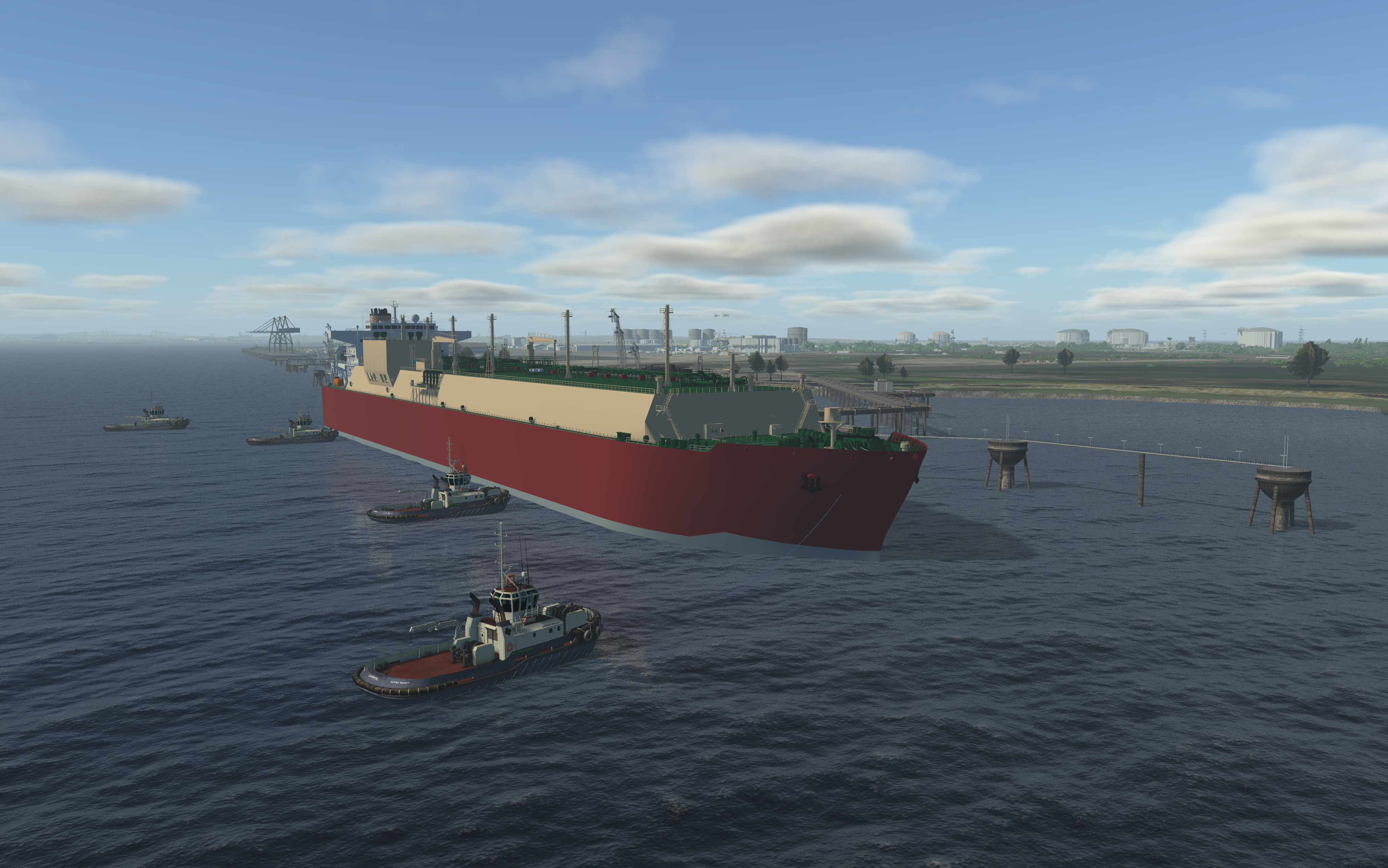
The value of S-100 for deep-draught vessels in tidal, constrained channels is much as was set out in 2020. The S-101 electronic navigational chart provides the base layer; S-102 adds high-resolution bathymetry resolved to centimetres rather than coarse contour bands; S-104 and S-111 bring dynamic water levels and surface currents; and S-129 supports under-keel clearance management. For an LNG carrier working a long-tidal, controlled transit window, the operational prize remains the ability to plan to the vessel’s actual draught and the real tidal height, widening access and operability windows while protecting safety margins. Yet charts, however dynamic, describe the environment. They do not tell a pilot what will happen if a tug is made fast a minute late, if an engine trips in a cross-current, or if a chosen speed is fractionally too high for the bend ahead. The next frontier is not a better description of the water – it is a credible anticipation of outcomes. That is where AI advisory tools come in, and where the harder engineering problem lies.
The appeal of an AI-based pilot and tug-assist advisory tool is easy to state: an early-warning system that recognises a developing situation and proposes safe alternative paths. The obstacle is data. Supervised ML needs vast, labelled datasets, and not just of routine arrivals and berthings, but of the rare, dangerous combinations of speed, tug configuration, weather, tide, and equipment failure that define the edge of safe operation. The alternative to synthetic data would be to wait and collect enough real-world data to populate those datasets. In practice that would take many years and is not a sensible option – not least because the most instructive scenarios are precisely the ones no port wants to experience. The way through is to generate the data synthetically, at scale, in a high-fidelity simulation of the specific port and ship.
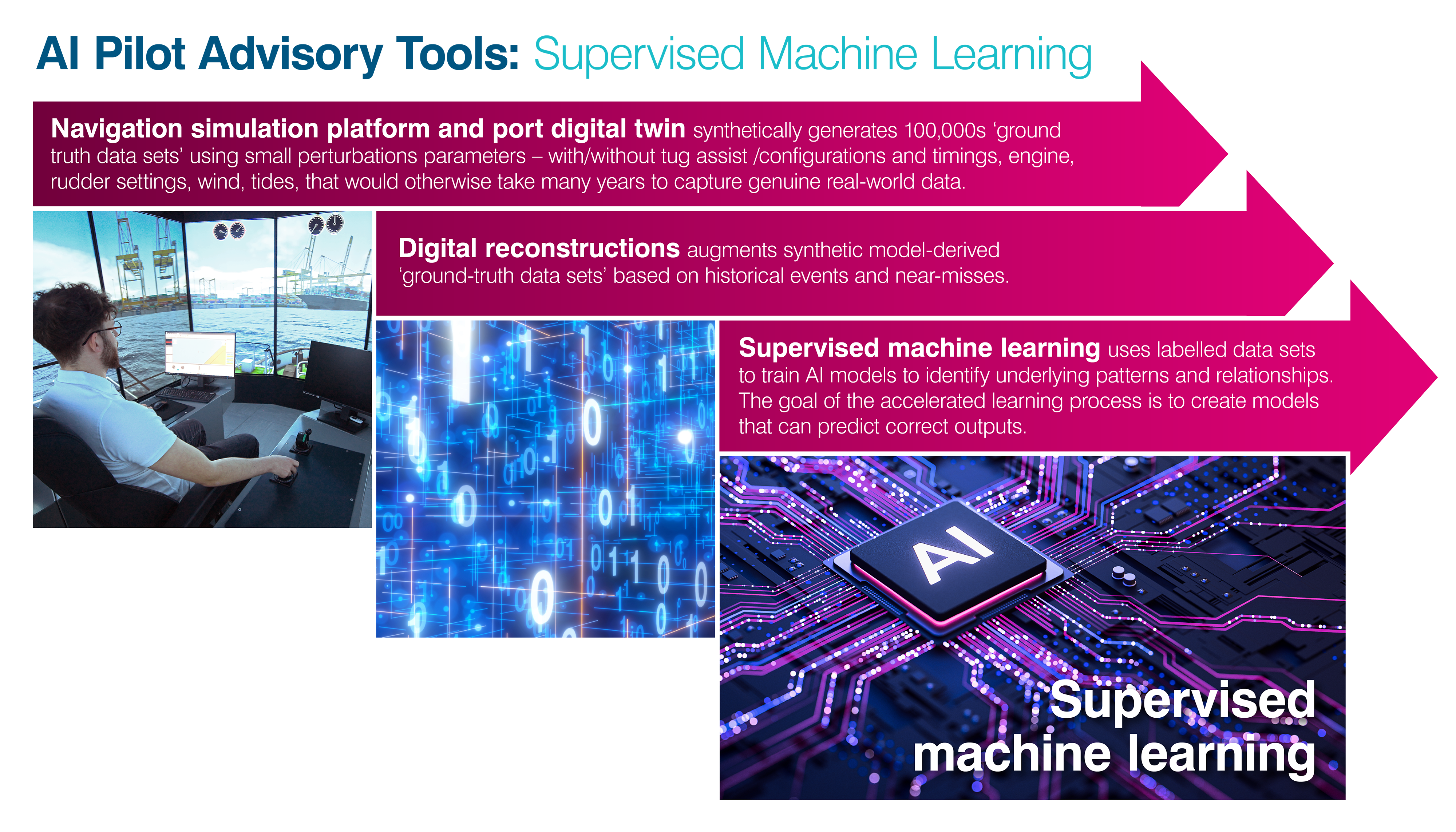
This is an area BMT has been exploring through REMBRANDT, its real-time manoeuvring, berthing, and training simulation platform. The approach is less a novelty than a long evolution: REMBRANDT is DNV-accredited and has been used for port feasibility and pilotage studies for over 35 years, building on a heritage in maritime simulation that reaches back through the National Maritime Institute and 60 years of operating towing tanks and manoeuvring basins. What is new is the ML layer now placed on top. Recently brought together with synthetic environments and a remote operations centre in BMT’s new Digital Innovation and Simulation Centre, and operating as a port-specific digital twin, the platform can generate hundreds of thousands of synthetic ‘ground-truth’ datasets by running ship and port-specific manoeuvres with small perturbations in each scenario: tug assist configuration and timing, bollard pull, engine and rudder settings, the pilot’s chosen speed, wind, and tide. Crucially, the same approach can model emergency responses such as loss of propulsion, loss of steerage, tug failure, and collision-avoidance measures – the very events that real-world data sets so rarely capture. BMT has worked in collaboration with the US NTSB, the UK MAIB, and Singapore TSIB for several years to develop a range of digital forensic tools in REMBRANDT that allows the augmentation of this ML approach. Alongside synthetic data generation, the simulator can reconstruct real incidents and near-misses using direct feeds from voyage data recorders (VDR), automatic identification systems (AIS), and portable pilot units (PPUs).
This digital-forensic capability allows historical events to be replayed in 3D and then folded back into the training environment so that ML models learn from genuine casualties as well as simulated ones. Trained on these combined datasets, recurrent neural networks can offer path-planning suggestions and warnings for potential incidents arising from the variables in any chosen scenario. The intent is not to remove the pilot or tug master from the decision, but to give them an early warning system and a set of safe alternative paths grounded in both historical and synthetic experience. It is one approach among several the industry is pursuing; the broader and more durable point is the method, fusing state-of-the-art simulation, digital forensics, and supervised ML to compress decades of operational experience into something usable today.
The same digital reconstruction capability has an obvious application after a serious casualty. Recent high-profile incidents – among them the loss of the Francis Scott Key Bridge in Baltimore in 2024 – are a brutal reminder of how quickly a single ultra-low probability failure can trigger an extreme, catastrophic event when it occurs in in a confined channel and in the vicinity of critical infrastructure. The combination of ultra-low probability but high consequence events represents a traditional blind spot in the training of masters, pilots, and other port and terminal stakeholders. But this is exactly where digital forensics and synthetic, data-based ML can fill the void.
Generating such events in a high-fidelity synthetic environment and exploring how different emergency response strategies (e.g. escort tug policies, emergency anchorages, channel transit speeds) might have unfolded, builds a transferable digital library of lessons for port and terminal risk assessments and stakeholder training.
The aim is never to second guess those who faced an unforgiving situation in real time, but to learn from it collectively. As vessel sizes and traffic density continue to increase and intensify in many ports, that kind of structured, simulation-led learning is becoming a basic tool of due diligence rather than a refinement. There is a human dimension to this that is easy to overlook. Work on crisis decision-making consistently shows that time is the enemy of good judgement: under acute pressure, people decide faster, lean more heavily on heuristics and bias, and tend to produce lower-quality outcomes. What counters this is prior experience and the rare, high consequence scenario is precisely the one a pilot or tug master is least likely ever to have met. A synthetic training environment and even a synthetic, data-based ML pilot advisory tool would offer a way to close that gap, letting crews rehearse the worst case repeatedly and safely, so that when seconds matter the response is drawn from experience rather than improvisation. It is the point at which the data problem and the human problem turn out to be the same problem.
2026 is proving a landmark year for the policy framework around all of this. Alongside S-100 becoming operational, the International Maritime Organization (IMO) adopted its first Code of Safety for Maritime Autonomous Surface Ships (the MASS Code) at MSC 111 in May 2026. Adopted as a non-mandatory, goal-based instrument effective from 1 July 2026, it sets out a framework intended to hold remotely operated and autonomous ships to the level of safety, security, and environmental protection expected of a conventional ship, with a structured experience-building phase to follow and a mandatory code targeted for the early 2030s.
Notably, the code keeps the human element and accountability at its core. For port and terminal operations, the realistic near-term picture is not crewless ships but a spectrum of supervised, autonomous, and remotely-supported operations, and harbour tugs may well sit at the leading edge of that transition, as projects such as the IntelliTug collaboration in Singapore have shown. The same synthetic data-and-forensics method that can train a human advisory tool is precisely what is needed to train and assure future autonomous designs. Demonstrating that such a system behaves safely and correctly is best done in a synthetic environment first, where extensive, accelerated performance ‘stress-testing’ includes all forms of extreme scenarios that can be deployed, allowing incremental improvements before autonomous designs even enter the water. That, too, is how the evidence base for the experience-building phase will, in part, be built. For the master mariners and pilots at the heart of these operations, the code’s insistence on human judgement and accountability is precisely the reassurance this transition needs.
It would be a mistake to treat the safety case and the sustainability case as separate. The industry increasingly describes the port of the future in four words – smart, safe, secure, and sustainable – and the threads are more tightly bound than they first appear. Optimising speed in channels, widening long-tidal operability windows, and selecting the best tug deployment options (the operational prizes that richer data first unlocked) all reduce fuel burn and emissions while improving port access. Fewer incidents also avoid the very real environmental and economic costs of a casualty. The dynamic data layers now arriving under S-100 underpin all of it, and ML advisory tools help translate that data into the marginal decisions that, aggregated across thousands of port calls, add up to a more efficient and lower-carbon operation.
This is also where navigation safety meets the wider decarbonisation agenda that ports, consultancies, classification societies, and academia are increasingly tackling together, from future fuel road-mapping to the environmental and economic modelling that quantifies the trade-offs. None of it is the work of any single organisation; the value lies in connecting the data, disciplines, and institutions that have historically sat apart. In short, safety and sustainability are two sides of the same decision: the same richer data and decision support that make a port call safer are exactly what make it cleaner. None of this displaces the seafarer. The pilot and mariners remain the decision-makers; the role of the data, the simulation, and the advisory tool is to widen the options in front of them and to flag risk earlier than instinct alone would allow. That principle – keeping human judgement and accountability at the centre, even as the systems around them grow more capable – is the same one the IMO has written into the foundations of the MASS Code, and it is the right one to carry into everything that follows.
In 2020, the argument was that progressive data fusion would make navigation smarter and safer. In 2026, the data standards are arriving on the bridge, and the methods to exploit them, fusing simulation, digital forensics, and ML, are maturing fast. The opportunity is to move from describing the environment to anticipating it: safer pilotage, better-trained tug masters, a credible and well-evidenced path towards progressive, assured autonomy, and ports and terminal operations that are at once safer and more sustainable. The tools to support that journey are taking shape; the task now is to apply them thoughtfully, with safety and the human element firmly at the centre.

Since joining BMT in 1992, Phil has held various managerial and executive appointments within BMT’s global management consultancy.
His extensive work in e-Navigation, Traffic Simulation, Digital Twinning and Digital Reconstruction Forensics has led to the world’s leading ship operators and statutory marine accident investigation bodies to adopt BMT navigation simulators for port planning and navigation training. Users include Shell, the U.S. National Transportation Safety Board and counterparts in the U.K., Australia and the Netherlands. Phil is also currently leading a number of joint industry developments in Autonomous Surface Vessels, Artificial Intelligence, Deep Learning and Machine Vision Capabilities and the impacts on Future Port Design.
Phil has held several Directorships with the Transport, Offshore and Marine Surveys divisions at BMT. Prior to joining BMT, he worked in underwater acoustics at BAE Systems and as a Professor at the Department of Aerospace and Ocean Engineering at Virginia Tech, U.S.A.
He has received a Civil and Structural Engineering doctorate from Newcastle University and an MBA from Durham University. Phil is registered as a Chartered Director with the UK’s Institute of Directors.

Jake Rigby - UK / Europe
Discover how AI can help shipowners, operators and engineering teams navigate decarbonisation, regulatory complexity and operational challenges through improved decision-making and knowledge management.

What if your biggest cyber risk isn’t the next breach, but sensitive data being captured today and exploited years from now?

Chloe Yarrien
Maritime Autonomous Systems (MAS) are moving from concept to operational reality. Across defence and commercial maritime sectors, organisations are exploring how autonomy can improve operational effectiveness, increase persistence, reduce risk to personnel and enable new ways of working.

Dr Thomas Beard - UK / Europe
John Bensalhia from the IMarEST talks to Thomas Beard and Jake Rigby, about the potential benefits, difficulties and future outcomes of making nuclear-powered vessels a reality.