When conversations turn to Australia's maritime future, the focus often falls on major infrastructure investments, fleet expansion and emerging technologies. Yet delivering on those ambitions requires more than investment alone.
As activity across the sector continues to grow, so too does the need for skilled workforces, established supply chains and specialist engineering capability.
Building that capacity isn't simply a matter of investment. It requires regions with established maritime expertise, proven industry capability and a willingness to continue adapting to meet future demand.
For Damien Richards, Associate Principal Engineer at BMT, that capability and willingness is particularly evident in North Queensland. Having spent 18 years in the Royal Australian Navy before building a career in Cairn's maritime engineering and sustainment sector, Richards has seen firsthand how the region's maritime industry has evolved over time.
"The conversation in industry is often about what North Queensland could become. But when you look at the capability that's already here, the skills, the infrastructure, the shipyards and the supply chains, the region is already playing an important role in Australia's maritime sector."
North Queensland as a maritime capability hub
In Richards view, one of the biggest misconceptions about North Queensland is that its maritime capability is still emerging:
"North Queensland is not preparing to become a maritime hub, it already operates as one. Nowhere is that more evident than in Cairns, where the capability, skills and experience have been built over decades through sustainment, engineering and operational activity across the region."
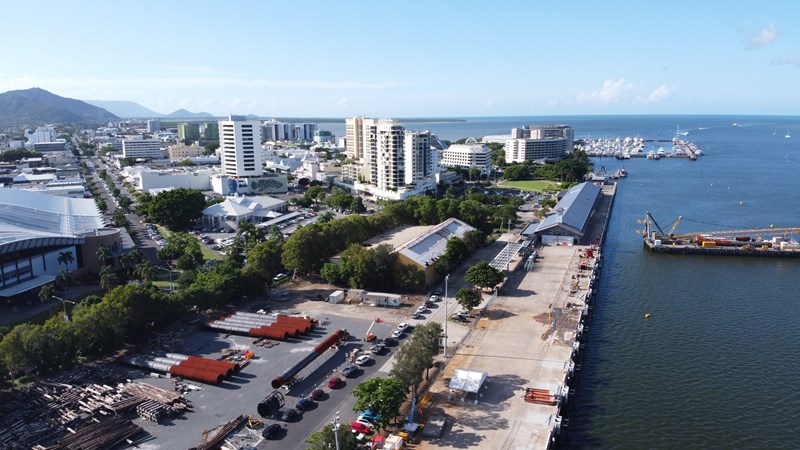
Cairns is home to the Royal Australian Navy's first Regional Maintenance Centre, and the marine precinct has supported naval, border protection and Pacific-partner vessels for many years. The city is also home to three established shipyards, supported by specialised supply chains and maritime service providers that continue to deliver sustainment, repair, maintenance and engineering services for commercial, government and defence operators.
Supporting this established industry is a strong skills pipeline, with universities, TAFE and specialist training providers helping to develop the next generation of engineers, tradespeople and maritime professionals. From 2027, students at James Cook University will be able to enter a Maritime Engineering major, completing the first two years of their degree locally before progressing to specialist studies with the Australian Maritime College in Launceston. Designed specifically for the industry, pathways like this ensure critical maritime skills continue to be developed and retained in the region.
Complementing this growing workforce is a pipeline of infrastructure investment designed to expand the region's capacity. A $250 million wharf upgrade at HMAS Cairns, including a new 212-metre wharf, will support parallel and double berthing for current and next-generation patrol vessels, as well as visiting ships from Australia's Indo-Pacific partners.
Alongside this, the planned Common User Facility will introduce a 5,000-tonne shiplift capable of accommodating vessels up to 120 metres in length, expanding the region's capacity to support more complex sustainment and maintenance activities.
The opportunity for North Queensland is clear. As the sector continues to grow, the region can build on the expertise, workforce capacity and infrastructure already in place to support national priorities and international markets.
Connecting Australia's maritime capability with the Pacific
While capability provides the foundation, geography plays an equally important role in North Queensland's growing influence on Australia's maritime sector.
Positioned on Australia's northern coastline, the region serves as an important connection point between Australia's maritime sector and the broader Indo-Pacific. Cairns is Australia's natural gateway to Papua New Guinea and the Pacific, with direct flights to Port Moresby and a long history of supporting vessels operating across the region, including those of Australia's Pacific partners.
As Australia's strategic focus continues to shift north, maintaining and sustaining vessels closer to where they operate offers practical advantages, improving availability, reducing transit times and keeping assets where they are needed most.
As Richards notes, the region's strategic position remains one of its greatest strengths:
"North Queensland's strategic position and supply chains remain some of its greatest strengths. We're geographically positioned for maritime activity across the Pacific, and that combination of capability, connectivity and proximity to key markets positions the region to play an even greater role in supporting Australia's maritime future."
Driving the next phase of Australia's maritime growth and innovation
The next phase of growth for North Queensland's maritime sector will be driven by innovation, technology adoption and the shift towards data-driven, through-life sustainment.
From digital asset management and autonomy to AI-supported inspections, drone-enabled assessments and hybrid fleet support, these emerging capabilities are changing how maritime assets are maintained, monitored and supported throughout their lifecycle, while creating demand for new skills across the sector.
"The opportunity is in how we introduce these technologies into the way we do business. Whether that's using unmanned systems to conduct inspections, improving decision-making through data, digitising shipyards or finding more efficient ways to deliver sustainment, there's a real opportunity to build on the capability that's already here."
These technologies are already moving from concept to application across the maritime sector, with increasing investment in autonomy, data-driven decision-making and through-life asset management. For North Queensland, the next step is building on decades of maritime expertise as these new approaches become more widely adopted.
Supporting the future of Australia's maritime sector
Having spent his career on both sides of the maritime sector, first as a member of the Royal Australian Navy and now supporting clients across industry, Richards has seen firsthand how regional capability contributes to national outcomes.
From his perspective, delivering on Australia's maritime ambitions requires more than investment alone. It depends on organisations being able to connect infrastructure, engineering, sustainment and technology across the full life of a maritime asset.
"BMT delivers across the full lifecycle of coastal assets, from the environmental and infrastructure planning that enables a project to move forward, through to maritime engineering, sustainment, upgrades and eventually decommissioning."
"Whether that be a wharf, a ship, or a channel, it's all connected. Understanding how those systems interact, and how decisions in one area affect another, helps organisations improve efficiency, safety and long-term asset performance."
North Queensland has the established maritime expertise, proven industry capability and skilled workforce needed to support Australia's growing maritime ambitions. With infrastructure investment expanding the region's capacity and new technologies reshaping sustainment, the opportunity now is to scale these foundations while continuing to adapt to future demand.
BMT supports that progress by connecting infrastructure planning, maritime engineering, asset management and sustainment expertise across the life of complex vessels and coastal assets. This integrated approach helps government and industry make informed decisions, manage change and realise greater long-term value from their investments.
Learn more about how we support vessels, ports, marine infrastructure and coastal assets throughout their operational life: How we work with our customers.


